












Better Ice Starts with Better Water
When operators think about beverage quality, they usually focus on coffee beans, tea blends, syrups, recipes, or presentation. But one of the most important ingredients in a cold beverage is often overlooked: ice.
Whether it’s an iced coffee, cold brew, iced tea, sparkling water, fountain beverage, or cocktail, ice becomes part of the drink the moment it begins to melt. If the water behind that ice contains off-tastes, excess hardness, chlorine, scale-causing minerals, or inconsistencies, it can affect the guest experience and put added strain on equipment over time.
To better understand the connection between water quality, ice quality, and beverage performance, we spoke with Charlie Neuman, Vice President of Sales & Marketing at FAIM Reps, and Ryan Wolfrum, Business Development Manager for Professional Filter at Vivreau. Together, they shared practical advice for operators looking to improve beverage quality and protect their equipment.
Q: Why should operators think about ice as an ingredient?
Charlie:
Ice is food. People consume it, and it impacts the beverage experience.
In drinks like iced coffee, iced tea, and specialty beverages, flavor isn’t heavily masked. If the ice introduces unwanted taste or odor, guests notice it. The water used to make the ice matters just as much as the water used to brew the beverage itself.
Ryan:
Many beverage programs are designed around dilution. Operators intentionally brew coffee or tea stronger than the final target because they know ice will melt into the drink.
If the ice contributes unwanted flavors or inconsistencies, it can undo all the work that went into creating the beverage recipe.

Ice doesn't just cool a beverage. It becomes part of the beverage.
Expert Takeaway
Q: What are the biggest factors affecting ice quality?
Charlie:
The first factor is source water.
Every municipality treats water differently, and water conditions can vary dramatically between regions. Some areas have naturally soft, clean water. Others deal with high hardness, excessive minerals, sediment, chloramines, chlorides, or other challenges.
The second factor is whether the building has any water treatment in place before the water reaches the ice machine.
The third factor is the point-of-use filtration serving the equipment itself.
All three layers influence both ice quality and machine performance.
Ryan:
The only reliable approach is to test the water first. You can’t choose the correct treatment solution until you understand what you’re trying to address.
A successful filtration strategy starts with understanding local water conditions, not guessing.
Water testing should always come before filter selection.
Q: What ice-related problems do operators experience most often?
Charlie:
The two biggest issues are scale buildup and biological growth.
Scale forms when minerals accumulate on internal machine components. Over time, it can reduce efficiency, increase maintenance requirements, and affect ice production.
The second issue is slime growth. Ice machines create a cold, moist environment that can support biological growth if cleaning schedules aren’t maintained.
Ryan:
Many operators remember to service the machine itself, but filter replacement is often overlooked. A filtration system can only perform as intended if it’s maintained properly.

Common warning signs include:
Scale buildup
Slime or biological growth
Off-tastes or odors
Reduced ice production
Increased service calls
Filter neglect
Q: Does cloudy ice always mean there’s a water quality problem?
Charlie:
Not necessarily.
Cloudy ice can sometimes be caused by dissolved minerals or hardness, but machine design also plays a role.
Residential ice makers freeze slowly, allowing air to become trapped inside the ice. This often creates cloudy or white-looking cubes even if the water itself is clean.
Commercial ice makers typically freeze more quickly, producing clearer ice. In those applications, excessive hardness or dissolved minerals may become a larger contributor to cloudiness.

Cloudy ice can be a water issue, but it can also be a machine or freezing-process issue.
Q: Is removing everything from the water the best solution?
Ryan:
No. More filtration isn’t always better filtration.
Charlie:
Ice machines need some mineral content to operate properly. Most commercial machines rely on conductivity sensors or water probes that require minerals to function correctly.
Extremely demineralized water can create operating issues and may even contribute to equipment wear.
Ryan:
There is also a cost and sustainability consideration.
If incoming water quality is already good, a more aggressive treatment approach may add expense and water waste without delivering meaningful benefits.
The goal is not to remove everything. The goal is to remove the right things.
Q: What should operators consider when choosing filtration?
Ryan:
Different applications require different filtration strategies.
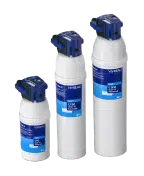
For operators seeking precise control over mineral reduction, the Vivreau PURITY C platform offers adjustable bypass technology that can optimize both water quality and cartridge life.
For many ice applications, the Vivreau high-capacity, high-flow (HCHF) platform provides strong taste and odor reduction while supporting higher flow rates and extended service intervals.
Charlie:
The right solution depends on:
- Water hardness
- Water chemistry
- Chlorine or chloramine levels
- Equipment specifications
- Operational volume
- Desired beverage outcomes
Choose filtration based on your water and application, not a one-size-fits-all approach.
Q: Why do identical ice machines perform differently across locations?
Charlie:
Water isn’t the only variable. You also need to consider:
- Ambient temperature
- Water temperature
- Water pressure
- Humidity
- Customer demand
- Local infrastructure
- Biological factors such as yeast-heavy environments
A machine that performs perfectly in one city may require a different filtration strategy or production capacity in another.
Ryan:
Water pressure is often overlooked as well. Too little pressure can reduce performance. Excessively high pressure can cause unnecessary stress on equipment.
Location matters. The same machine won't perform identically everywhere.
Q: If an operator wants better ice, where should they start?
Charlie:
Start by understanding your water.
Ryan:
Then understand your equipment.
Charlie:
And once you’ve selected the correct filtration solution, maintain it consistently.
A quality filter that isn’t changed on schedule can’t do its job.
Final Advice
If you’re looking to improve cold beverage quality, start by treating ice as part of the beverage program rather than an afterthought.
Better-tasting water supports better ice.
Better ice supports better beverages.
And better beverages create better guest experiences.

Choosing the right filtration strategy starts with understanding your water and application.
Explore Vivreau’s filter portfolio to compare solutions for ice machines, beverage equipment, and high-volume service environments: View Vivreau water filters
Special thanks to Charlie Neuman and Ryan Wolfrum for taking the time to answer our questions and share their expertise on water quality, ice performance, and filtration strategy.
To ask your own questions or continue the conversation, contact Charlie Neuman at charlie@faimreps.com or Ryan Wolfrum at rwolfrum@vivreau.com.
Latest Posts


