










TL;DR
Limescale is a hard calcium carbonate deposit that flattens the taste of coffee and shortens the life of brewing and steam equipment, and the practical fix is a filter built to reduce scale paired with a regular descaling routine.
-
- Why hard water turns into scale inside a boiler, and the four ways that scale causes failure
- How to spot a limescale problem before it becomes equipment damage
- Which filter type actually reduces limescale, and why a standard carbon filter does not
Watch our webinar on limescale with Maria and Anastasia!
This article was originally written in 04/2025 and has since been updated in 09/2026 to reflect new findings and data points.
“Bad coffee led me to discover limescale buildup in my friend’s brewer. A quick descale, and the flavor was totally transformed.”
That was a recent experience of Maria Cleaveland, a coffee expert with Urnex. In this Q&A, Maria teams up with Vivreau’s water sommelier Anastasia Chovan to talk about limescale, how it affects coffee and coffee equipment, how a water filter can help, and how to keep your equipment in top shape.
How does water content affect my coffee and coffee equipment?

Anastasia: Water contains minerals. Some of those minerals are good, some are not. One of the most problematic mineral complications for coffee and coffee equipment is limescale. Limescale can make your coffee taste flat and reduce the lifespan of your coffee and steam equipment.
Image: Severe limescale buildup inside a boiler
What is limescale?
Anastasia: Limescale is a hard, chalky deposit primarily composed of calcium carbonate (CaCO₃).
How does limescale form in my coffee equipment?
Maria: When water is heated, the minerals calcium and hydrogen carbonate come out of suspension and bind together in the boiler to create limescale and on other metal parts of the machine.
How does limescale affect my equipment?
-
If you don’t keep it out of your equipment, it causes problems such as
- Temperature surfing, meaning the temperature output of your water will be inconsistent
- The boiler must work harder because it has to heat through the minerality leading to premature aging of equipment / breakdown
- Mineral build up on the water level sensor may lead to the boiler being underfilled or overfilled, leading to leakage and flooding
- Catastrophic damage –the water inlet or outlet can become clogged, causing the boiler to burn out
Temperature Surfing
When scale builds up on temperature sensors, it causes the boiler to misfire — either overheating or underheating the water. This is known as temperature surfing, and it leads to poor extraction and inconsistent coffee.
The graph below shows erratic temperature changes that can happen when scale interferes with accurate sensor readings.

Scale buildup doesn’t just damage your equipment—it drives up your energy cost
This chart shows how even a thin layer of limescale inside a boiler can dramatically increase energy use. For example, just 1/4 inch of scale can lead to a 40% spike in energy consumption.

How will I know if I have a limescale problem?
Maria: You might see white build up on the metal exterior spigots, spray heads or notice a reduced flow rate, or observe inconsistent water temperatures.
Why does my limescale build up tend to be worse at different times of year?
Anastasia: Limescale presence can fluctuate based on seasonal water sources. Some regions will change where they source their water from based on drought and other factors thereby affecting the mineral content of the water. Watch Beyond the Tap | Seasonal Changes in Water
Will my carbon-based water filter remove limescale?
Maria: No, standard carbon filters do not remove limescale. You may be filtering your water, but you are likely only taking care of taste and odor.
What is the best way to prevent limescale?
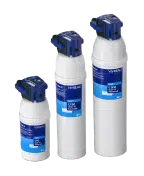
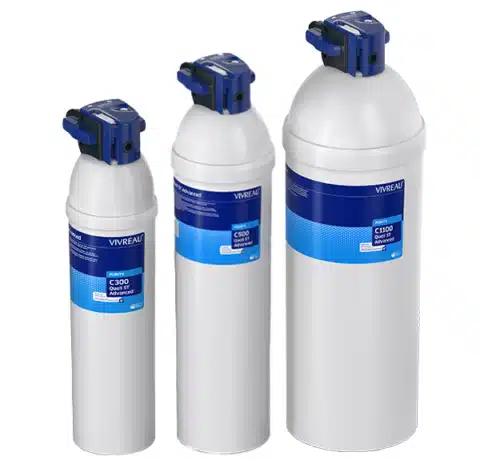
Anastasia: Let’s start by trying to keep limescale components out of your system by using a specialty filter such as Vivreau’s PURITY C Advanced and Xtrasafe filters. These water filters are specifically designed to reduce limescale.
Maria: Despite best efforts, limescale build up may still occur. A regular descaling routine can help.
What Are the Top-Rated Water Filtration Systems That Support Workplace Wellness Programs?
Coffee is usually the most-used part of a workplace beverage program, so the filtration behind it does double duty. It protects the equipment, and it protects the taste people judge the whole program by.
Start with your water. USGS classifies water above 121 mg/L as calcium carbonate as hard, and above 180 mg/L as very hard. The harder the supply, the faster scale forms on boilers, sensors, and spray heads.
Then match the filter to the problem. Carbon-only cartridges address taste and odor. Reducing scale requires a filter built for it, such as PURITY C Advanced or PURITY C1100 XtraSafe.
Finally, plan the routine. Filtration slows scale, it does not remove what has already formed, so pair it with a scheduled descale and a capacity calculation so cartridge changes land before performance drops.

We hope you found this article educational and are feeling empowered to handle your limescale issues.
Here are some additional resources to help you get started: Urnex descalers
FAQs
-
Does a carbon water filter remove limescale?
No. A standard carbon filter is built to reduce chlorine, taste, and odor compounds, not the calcium and hydrogen carbonate that form scale. Water can taste noticeably better and still leave the same chalky deposits inside a boiler. Reducing scale needs a cartridge designed for it. The practical test is simple: if you are filtering for flavor only, assume your equipment is still accumulating scale. Check the cartridge specification for scale or carbonate hardness reduction rather than assuming filtration is a single category. Where the supply is hard, pair the right cartridge with a descaling schedule, because neither one alone keeps a boiler clear over a full year of use.
-
How do I know if limescale is building up in my coffee equipment?
Look for white or chalky deposits on exterior spigots and spray heads, a reduced flow rate, and water temperatures that drift between brews. Inconsistent extraction is often the first thing anyone notices, before a deposit is visible. Scale on a temperature sensor makes the boiler misfire, overheating or underheating the water, which is why the cup can taste different from one hour to the next. Rising energy use is another signal, since the boiler has to heat through the deposit. If more than one of these appears together, treat it as a scale problem and check the boiler rather than adjusting the grind or the dose.
-
How much does limescale cost in energy and equipment life?
Scale acts as insulation between the heating element and the water, so the boiler runs longer to reach the same temperature. A quarter inch of scale inside a boiler can raise energy consumption by roughly 40 percent. The equipment cost usually arrives later and larger: sensors that misread and underfill or overfill the boiler, leaks, clogged inlets or outlets, and premature failure of a machine that should have lasted years longer. Because the buildup is gradual, the operating cost tends to get absorbed as normal before anyone connects it to water. Tracking energy use and service calls against local water hardness makes the cost visible enough to justify the filter.
-
Why does limescale seem worse at certain times of year?
Because the water itself changes. Municipalities shift between sources during drought, seasonal demand peaks, and maintenance work, and each source carries a different mineral load. A supply that ran moderately hard through winter can move into the hard or very hard range for part of the year, and scale forms faster during those stretches. That is why equipment that behaved for months can start surfing temperature in a single season. Rather than reacting each time, size filtration for the hardest reading your area sees and set descaling intervals against that figure, not the annual average. Your water utility publishes an annual water quality report with hardness data for your area.
Latest Posts


