












Key Takeaways
- Coffee is nearly all water, so a cafe’s biggest ingredient is also the one most brew recipes rarely test.
- The Specialty Coffee Association’s standard sets a target range for total dissolved solids, hardness, alkalinity, pH, and chlorine, not a single ideal number.
- Newer research contradicts older research on how precisely mineral content affects extraction, though both agree that the target window still matters.
- Espresso, batch brew, and hot water taps stress water differently, so matching filtration to each machine protects the cup and the equipment.
A commercial espresso machine keeps its boiler within about 1 degree Fahrenheit of the target. A scale dose grounds to a tenth of a gram. Yet the ingredient that fills most of the cup often goes unmeasured once it leaves the tap.
The best water for coffee is not a single number pulled off a spec sheet. It is a window that protects both the cup and the machine. Understanding where that window comes from, and where the research is still working out the details, is what turns a recurring taste complaint into a fixable variable.
Coffee Is Almost All Water, So the Water Is Part of the Recipe
Coffee is roughly 98% water once it hits the cup, so the water is not a background ingredient. It is the largest ingredient by far, and it carries every flavor compound the grounds release.
A cafe controls the rest of the recipe with real precision. The bean origin and roast date are chosen on purpose. Grind size is dialed to the burr. Dose is weighed to the tenth of a gram. Water temperature and contact time are set on the machine and rarely touched again.
Water quality is part of that same conversation. The Specialty Coffee Association has published a brewing water standard for over a decade. It just tends to get less day-to-day attention than the variables a barista adjusts every shift, and the incoming supply is often accepted as a given rather than actively managed.
That handoff is where consistency breaks down. A utility can shift its source blend seasonally, drawing more from a reservoir in summer and more from groundwater in winter, and the mineral profile moves with it even though nothing on the brew ticket changed.
A multi-location program can run the same recipe in two cities on the same supplier’s network and still taste different cups. Water quality varies by pressure zone and by how far the water traveled through local piping before reaching the machine.
The bean, the grind, and the machine settings can be identical. The water usually is not, and it is the one variable most brew recipes never account for.
What the Specialty Coffee Association Standard Actually Specifies
The Specialty Coffee Association’s water quality standard puts numbers on what good water actually means for brewing, rather than leaving it to taste alone.
These figures come from the SCA water standard, first published in 2009 and still the reference point cited across the industry:
- Total dissolved solids should fall between 75 and 250 parts per million, with a target near 150
- Calcium hardness should sit between roughly 17 and 85 milligrams per liter, with a target near 68
- Total alkalinity should land near 40 milligrams per liter
- pH should stay between 6.5 and 7.5, with a target of 7.0
- Chlorine should read at zero, and the water itself should be free of off odors and visible color
Each of those parameters is doing a specific job. Hardness gives extraction something to work with, since dissolved minerals help extract flavor compounds from the grounds. Alkalinity acts as a buffer against coffee’s natural acids, so it controls how much brightness carries over into the cup.
Chlorine has nothing to do with extraction and everything to do with taste, since even a small amount reads as a chemical or swimming pool note. None of these numbers describes an ideal water. They describe a window, and a cafe’s job is to keep its incoming supply within that window, regardless of the season or what the utility is doing.
How Minerals Change the Cup, and Where the Science Still Disagrees
The idea that specific minerals shape specific flavors traces back to a 2014 study built on density functional theory, which modeled how dissolved sodium, magnesium, and calcium bind to acid and flavor compounds in coffee. The modeling found that these cations compete with the coffee’s own acids during extraction, and that bicarbonate acts as a buffer against that acidity.
That buffering role is part of why alkalinity is treated as its own parameter rather than folded into hardness. The paper stopped short of naming one ideal water composition, noting that the right mineral balance depends on the specific roast being brewed.
A decade later, a Heliyon study put that framework to a direct test. Researchers spiked coffee with magnesium and calcium at two different points, once before brewing and once after, then measured how the finished cup’s organic acids changed. Ordinary drinking water levels of those minerals barely moved the needle.
 Whether the minerals went in before or after brewing made little practical difference either. That points toward acid extraction happening largely on its own, independent of what the water brought to it.
Minerals clearly still shape the cup somewhere in the process, just not primarily through that mechanism. The paper’s own authors did not soften the implication for their own field. “A scientific basis for water quality recommendations in the coffee industry is long overdue.”
Neither study contradicts the Specialty Coffee Association’s standard. Both point toward the same conclusion from different directions.
The target window is well supported by decades of cupping practice, but a precise mineral recipe that promises a specific flavor outcome is not something current research can back up. A cafe should stop hunting for the perfect mineral ratio and start managing the range instead.
The Two Failure Modes for Coffee Water: Too Soft and Too Hard
Water that misses the target window fails in one of two directions, and each direction changes both the cup and the machine differently. Too little mineral content leaves the extraction with nothing to grab onto.
Too many buffers mask the acidity that a good roast is built to show, and put their own kind of stress on the equipment. The fix for each is different, so it helps to know which one a cafe is actually dealing with.
Water That Is Too Soft
Water below the Specialty Coffee Association’s mineral floor, including reverse osmosis output that has not been remineralized, gives the extraction very little to hold onto. The resulting cup tends to taste thin, with a hollow middle and a sourness that reads as sharp rather than bright. It is tempting to assume that stripping water down to nearly nothing is the safe choice, since it protects against scale.
But very soft, low-alkalinity water can be aggressive toward the metal components inside a machine, corroding fittings and gaskets faster than properly mineralized water would. Soft is not automatically safe. It shifts the risk from scale to corrosion instead of removing it.
Reverse osmosis systems paired with bypass blending and remineralization, the same approach covered in Vivreau’s guide to preserving flavor and equipment, bring stripped water back into the target range. That is a more reliable fix than relying on raw RO output and hoping the cup improves.
Water That Is Too Hard
High alkalinity water buffers coffee’s natural acids before they ever reach the cup, which flattens the finished drink and mutes the brightness a light roast is supposed to have. That mechanism shows up in most brew guides. What few of them track is how hard water affects timing as it heats.
Bicarbonate reacts under heat and can slow extraction, an effect tied to how the coffee bed responds under pressure rather than grind size alone. A barista chasing a drifting extraction time by adjusting the grind alone may be solving the wrong problem, since the real cause is sitting in the water line, not the grinder.
The equipment side compounds the issue. Scale builds inside boilers and along steam paths wherever hard water runs hot, which is exactly the environment inside an espresso machine or a restaurant hot water dispenser running all day.
That buildup means more frequent commercial water dispenser maintenance calls, slower recovery between shots, and eventually a service visit that a cafe could have avoided by treating the water before it ever reached the machine.
Practical Targets for a Commercial Coffee Program
Turning the standard into something a cafe can act on starts with a single reference table, organized around what happens when a coffee shop’s water filtration system keeps the incoming supply within range and when it drifts outside that range.
| Parameter | Target Range | What It Governs | What Goes Wrong Outside The Range |
| Total Dissolved Solids | 75 to 250 ppm, target near 150 | Overall mineral load extraction pulls flavor into | Below 75 ppm, the extraction runs thin and sour. Above 250 ppm, the cup turns muddy and mineral-heavy |
| Calcium Hardness | Roughly 17 to 85 mg/L, target near 68 | Extraction strength and body | Too low, the shot pulls fast and tastes hollow. Too high, the scale accelerates inside the machine |
| Total Alkalinity | Near 40 mg/L | How much natural acidity survives extraction | Too low, acidity turns sharp. Too high, the cup flattens, and light roasts lose definition |
| pH | 6.5 to 7.5, target 7.0 | Whether the water itself is neutral going in | Outside this window, the water’s own chemistry competes with the coffee instead of supporting it |
| Chlorine | 0 mg/L | Odor and off-flavor | Any measurable chlorine reads as a chemical or swimming pool note |
Espresso, batch brew, and steam equipment do not always want the same treatment from the same incoming supply. Espresso forces water through a heated boiler under pressure for a short, intense contact time, making it more sensitive to hardness and scale than batch brew, where lower pressure and longer contact time allow a slightly wider window.
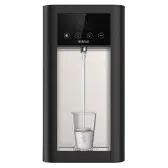
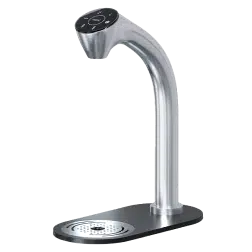
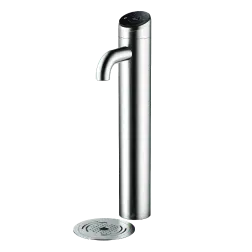
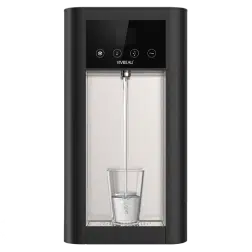
A commercial hot water dispenser feeding a tea service, or an instant hot water tap used for pour-over, faces its own version of the same math, since anything drawing hot water all day accumulates scale on the same schedule as an espresso machine. Phil McNerney, Senior Manager of Equipment at Odeko, one of Vivreau’s distribution partners, made this point in a recent interview with Vivreau.
Adjustable filter heads, he explained, let an operator preserve the minerals a specific water supply needs rather than filtering every location to one fixed setting. Matching the filter to the application, not just the building, is what keeps every station in range. None of it works without first testing the incoming water, since the target range only helps once a cafe knows where its own supply actually falls.
Getting Your Coffee Water Right in Your Space
The right water for a coffee program depends on the incoming supply at that address, the menu being served, and the machines pulling the shots, not on a single product picked off a shelf. That is why the starting point is a conversation rather than a purchase.
A single-location cafe and a growing multi-location program face different versions of the same question. Andytown Coffee Roasters’ expansion from one Ocean Beach location to nine across the Bay Area is a reminder that consistency gets harder to protect as a footprint grows, whether the product on tap is sparkling water or the brew water feeding the espresso bar.
Both dining room filtered water dispensers for guest service and kitchen water dispensers for back-of-house prep require the same rigorous testing and filtration standards as the primary coffee station.
Vivreau’s espresso and hot water filters are built around that same principle, matching filtration to the water a specific machine actually sees rather than a generic setting.
Request a quote to find the right filtration setup for your coffee program, from a single espresso machine to a multi-site rollout.
FAQs
-
What Are the Specialty Coffee Association’s Target Ranges for Brewing Water?
The standard sets a target window rather than one ideal number. Total dissolved solids should fall between 75 and 250 parts per million, with a target near 150. Calcium hardness should sit between roughly 17 and 85 milligrams per liter, targeting near 68. Total alkalinity should land near 40 milligrams per liter.
pH should stay between 6.5 and 7.5, targeting 7.0, and chlorine should read at zero. The water should also be free of foul odors and visible color. These ranges exist because extraction depends on the presence of certain dissolved minerals, but too much or too little in any category pulls the cup away from the balance a roaster designed the coffee to deliver.
-
Does Reverse Osmosis Water Make Good Coffee on Its Own?
Not usually. Reverse osmosis strips water down close to zero dissolved solids, which falls well below the Specialty Coffee Association’s floor and leaves the extraction with almost nothing to pull flavor into. The resulting cup typically tastes thin, hollow, and sharply sour rather than balanced.
Reverse osmosis becomes useful once the stripped water is remineralized back into the target range through bypass blending or a dedicated remineralization cartridge, which restores the calcium and alkalinity extraction depends on. Skipping that step and using raw reverse osmosis output is one of the more common ways a cafe accidentally creates the exact problem filtration was meant to solve.
-
Why Does the Same Espresso Recipe Taste Different at Two Locations on the Same Municipal Supply?
Because the same city rarely means the same water at two addresses. Municipal utilities often blend source water seasonally, shift between reservoirs and groundwater, and serve different pressure zones from different points in the distribution network, so two locations on paper can receive noticeably different mineral profiles in practice.
Local plumbing age and distance from the treatment plant add further variation before the water ever reaches the machine. A recipe dialed in at one address assumes a water profile that the other address may not actually have. Testing the incoming water at each location, rather than assuming citywide water is uniform, keeps a multi-location recipe consistent and avoids guesswork.
-
Should a Cafe Use Different Water Treatment for Espresso Than for Batch Brew?
Often, yes. Espresso forces hot water through a heated boiler under pressure for a short contact time, making it more sensitive to hardness and scale buildup than batch brewing, where lower pressure and longer contact time allow a slightly wider mineral window.
Steam equipment and hot water taps used for tea or pour-over add a third demand, since anything that draws hot water continuously scales on a schedule similar to an espresso machine. Rather than installing one filter sized for the whole building, matching filtration to each piece of equipment’s actual duty cycle protects both flavor and uptime more effectively than a single fixed setting applied everywhere.
-
How Does Brewing Water Alkalinity Change the Perceived Acidity of a Light Roast?
Alkalinity acts as a buffer that neutralizes coffee’s natural acids during extraction, so the more alkalinity in the water, the more of that acidity gets buffered away before it reaches the cup. A light roast depends on bright, well-defined acidity as part of its character, so water with high alkalinity can flatten it into something duller than the roaster intended.
Water with too little alkalinity swings the other way, making acidity taste sharp or unbalanced rather than bright. Staying near the Specialty Coffee Association’s target of roughly 40 milligrams per liter keeps enough buffering to round out the cup without erasing the acidity a light roast is built around.
Latest Posts


