











TL;DR
- Chlorine and chloramine both disinfect municipal water, but they behave differently once they reach your tap.
- Free chlorine is detectable at lower concentrations than chloramine, so identical utility practices can taste very different from one building to the next.
- Standard activated carbon removes free chlorine quickly. Chloramine requires two to four times the contact time, or a catalytic carbon specifically designed for that reaction.
In most municipal water systems across North America, chlorine is part of routine water treatment. Utilities add it in a small, carefully controlled amount because it is one of the most effective tools available for keeping water safe between the treatment plant and the tap. What changes from building to building is not whether the water is safe, but how it tastes once it gets there.
That difference comes down to how much disinfectant a system uses, which one it relies on, and how well a building’s filtration is matched to that supply. This piece looks at where the chlorine in tap water comes from, why the taste can shift depending on the season or the utility, and what filtration can actually remove.
Why There Is Chlorine in Your Water at All
Chlorine has been used to disinfect municipal drinking water in the United States since Jersey City, New Jersey, adopted it in 1908. Before large-scale chlorination, waterborne diseases, including typhoid, cholera, and dysentery, were common causes of death in cities that drew drinking water from contaminated surface sources. Chlorine’s introduction, along with filtration and other treatment advances, was central to eliminating those outbreaks as a routine public health risk in North America.
Utilities don’t just add chlorine once and move on. Water has to stay disinfected for the entire trip from the treatment plant, through miles of distribution piping, to the tap it eventually reaches.
That is why utilities maintain what is called a disinfectant residual, a small, continuously monitored amount of chlorine or chloramine that travels with the water the whole way. A treatment method that disinfects only at the plant, without leaving a residual, would not protect water that sits in a pipe for hours or days before it reaches a building.
Every utility in the United States is required to publish an annual water quality report, often called a Consumer Confidence Report, that discloses which disinfectant it uses and at what levels. That report, not a guess based on taste alone, is the most reliable way to find out what is actually in the water supply of a specific building.
Free Chlorine or Chloramine, and Why It Changes the Answer
Not every utility disinfects with the same chemical. Some use free chlorine on its own. Others add ammonia to create chloramine, a compound that now treats the tap water of more than one in five people in the US.
Chloramine is more stable than free chlorine. It produces fewer disinfection byproducts as water moves through the distribution system, and it holds up over longer runs. That is why some utilities have switched to it, and why a filter built for chlorine does not automatically handle chloramine the same way.
That distinction is exactly what separates drinking water systems for office and commercial spaces from a household filter bought off a shelf. The specification has to account for which disinfectant is actually in the supply.
Standard activated carbon removes free chlorine through a rapid surface reaction that converts it to chloride almost immediately. That is why a basic filter can handle chlorine without much contact time.
Chloramine’s bond is more stable, and the same carbon takes two to four times longer to complete the reaction, according to a technical review published in Water Conditioning & Purification. A filter rated for chlorine reduction is not automatically rated for chloramine reduction.
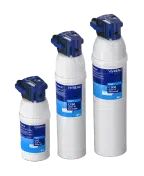
Catalytic and surface-enhanced activated carbons close that gap by reacting with chloramine directly, rather than relying on the slower conversion standard carbon needs. Our catalytic carbon filters are rated for up to 100% chloramine removal. That is the difference between a filter that technically reduces chloramine and one built to actually keep pace with it.
A catalytic carbon built to react with chloramine handles that complaint. A standard carbon block, built for chlorine, often does not.
Why You Taste It, and Why It Changes Through the Year
Taste and odor thresholds vary by disinfectant, and the differences are large enough to account for most of the chlorine taste complaints that buildings encounter. Free chlorine is detectable at 0.5-1 mg/L. Chloramine typically needs about 3 mg/L before people notice it.
Both thresholds sit below the EPA’s enforceable maximum residual disinfectant level of 4.0 mg/L. A compliant water supply can still taste noticeably different from one building to the next, depending on which disinfectant it uses and how close the residual sits to that detection point.
Residual levels are not flat across a distribution system, either. They tend to run highest near the treatment plant and fade as water travels toward the far ends of the network. That is one reason a water machine near the plant and one at the far end of the same network can taste noticeably different, even though both are fed by the same utility.
Utilities also flush lines periodically and, in some cases, switch from chloramine to free chlorine for a short seasonal burn to manage bacterial growth in the pipes. That switch alone can shift the taste a building notices, even when nothing about its own plumbing has changed.
Temperature plays a role, too. The same reaction chemistry that lets warmer water process disinfectant faster in a filter also tends to release more odor from water sitting in a glass or a pitcher. This is a general property of chemistry rather than a number that any single source publishes specifically for a glass of water.
If a complaint spans more than a single date, that is often the first place to look, alongside whether the building’s own filtration matches what the utility is currently running. Perception plays a role here as well, and presentation shapes perceived taste even when the underlying chemistry hasn’t changed.
What Filtration Actually Removes
Removing chlorine and chloramine does not require stripping out the minerals that make water taste full rather than flat. Reverse osmosis removes nearly everything dissolved in water, minerals included, which is why we don’t build our filtration around it.
Activated and catalytic carbon targets the disinfectant compounds specifically and leaves the mineral content that shapes how water actually tastes. That is the same logic behind good office water filtration, and behind any commercial system built to remove chlorine from tap water without also removing what makes it taste like something.

| Filtration Approach | What It Removes | What It Leaves In | Best Suited to |
|---|---|---|---|
| Standard activated carbon | Free chlorine, sediment, some organic compounds | Minerals, dissolved solids | Utilities using free chlorine |
| Catalytic/surface-enhanced carbon | Chlorine and chloramine, including compounds, standard carbon reacts slowly | Minerals, dissolved solids | Utilities using chloramine or switching seasonally |
| Reverse osmosis | Chlorine, chloramine, minerals, most dissolved solids | Very little | Applications where near-total dissolved solids removal is the goal |
Knowing what a filtration approach removes only tells part of the story. The rest comes down to what it has actually been tested and certified to do. Some filters are tested and certified for taste and odor. Others are tested and certified for health-related contaminants, which is entirely separate from how the water tastes.
A filter proven to fix a chlorine taste problem is not automatically proven to remove a health-related contaminant, and the reverse is true as well. The water treatment industry labels these two categories NSF/ANSI 42 for taste and odor and NSF/ANSI 53 for health-related contaminants.
A taste complaint calls for the first one, not the second. Vivreau’s filtration systems are certified to NSF/ANSI 42 for the reduction of aesthetic contaminants such as chlorine taste and odor, and applicable systems also carry NSF/ANSI 53 certification.
Closing the Gap Between Safe and Good
A chlorine taste complaint is usually a sign that the water chemistry has changed or that a building’s filtration is no longer matched to the local supply. An exhausted filter can certainly be the cause, but it is just as often a case of the filter technology not matching the water conditions in the first place.
Professional filtration starts with understanding the water source, not with selecting a filter off a spec sheet. The goal is to reduce compounds that affect taste and odor, such as chlorine and chloramine, while maintaining consistent water quality over time. When the filtration strategy is properly matched to the supply, both the taste complaints and the unplanned maintenance calls become far less common.
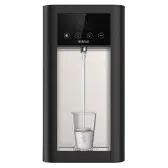
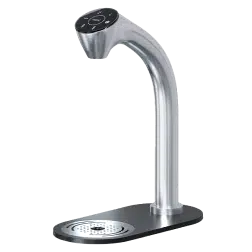
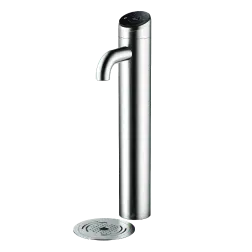
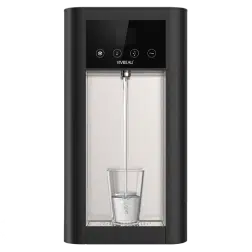
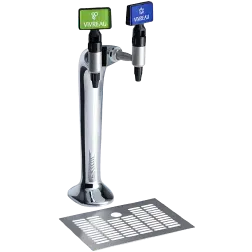
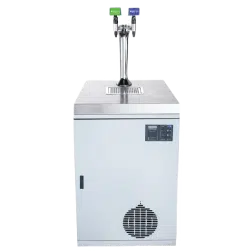
What that looks like varies by space. It might mean a compact, bottleless office water dispenser for a single break room. It might also mean a higher-volume, filtered water dispenser built for a food-and-beverage line that draws far more water per day.
That is the space between water that is safe and water people actually want to drink, and it is where our water filtration systems are built to work.
FAQs
-
Is Chlorine in Tap Water Safe to Drink?
Yes, at the levels municipal utilities are permitted to use. The EPA sets an enforceable maximum residual disinfectant level of 4.0 mg/L for chlorine and chloramine. Utilities must stay below that limit while maintaining sufficient residual disinfectant to keep water disinfected throughout the distribution system.
A taste or smell that is stronger than usual is far more often a sign of a seasonal adjustment, a system flush, or a filtration mismatch than a safety issue. Utilities publish an annual water quality report disclosing their actual disinfectant levels, which is the most direct way to confirm what a specific supply contains.
-
How Do I Find Out Whether My Utility Uses Chlorine or Chloramine?
Every water utility in the United States publishes an annual water quality report, sometimes called a Consumer Confidence Report, that discloses which disinfectant it uses and at what concentration. The CDC’s “Reading a Water Quality Report” guide explains what to look for in that document. A utility’s customer service line can also confirm this directly, and it is worth checking before assuming that a filtration system needs to handle one disinfectant rather than the other.
-
Why Does My Water Taste Different Depending on the Season?
Utilities adjust their disinfection practices throughout the year, including flushing distribution lines and, in some cases, switching from chloramine to free chlorine for a short period to manage bacterial growth in the pipes.
Because free chlorine is detectable at a much lower concentration than chloramine, a seasonal switch can produce a noticeably different taste even when the utility’s actual safety practices haven’t changed. Warmer water can also release more odor from a disinfectant already in the supply, which is part of why complaints often cluster in certain months.
-
Does Boiling or Refrigerating Water Remove the Chlorine Taste?
Free chlorine can dissipate from water left uncovered for a few hours because it is comparatively volatile. Chloramine is more stable and does not evaporate from standing water as readily, so leaving a pitcher out is a far less reliable fix once a utility has switched disinfectants.
Refrigeration can make a chlorine taste less noticeable without actually removing the compound. Filtration built for the specific disinfectant in use is the more consistent solution for either one.
-
Can a Water Filter Remove Chloramine as Well as Chlorine?
Not automatically. Standard activated carbon removes free chlorine quickly but needs two to four times longer to process chloramine. The reaction chloramine requires is simply slower than the one chlorine undergoes on the same carbon.
Catalytic or surface-enhanced activated carbon is designed to react directly with chloramine, closing that gap. A filter’s certification and its actual contact time both matter here, since a filter can be rated on paper for chlorine and chloramine reduction without being built to keep pace with chloramine specifically.
Latest Posts


